
Stories of the Bible
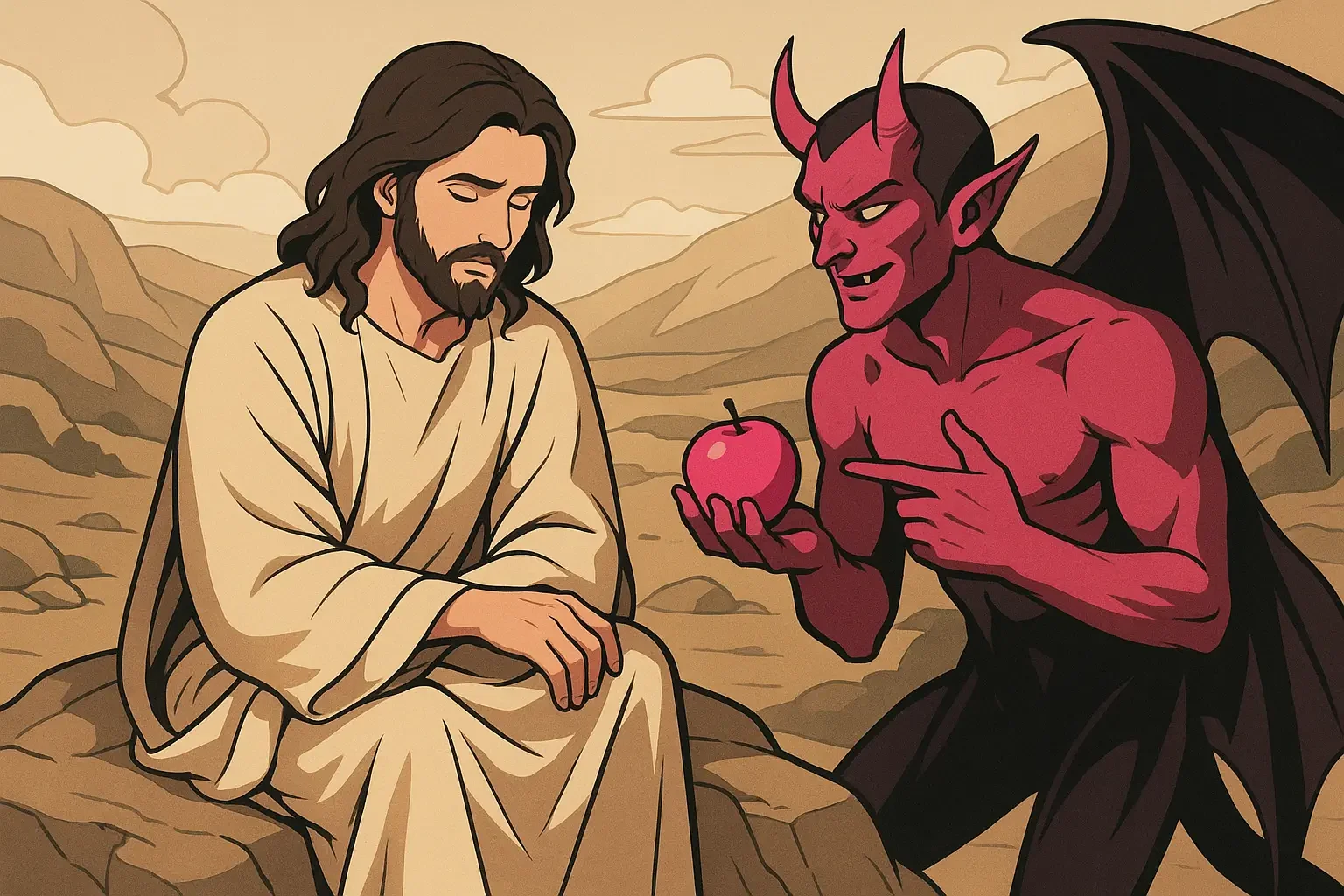
Exploring the Foundational Story of Jesus' Humanity, Sinless Obedience, and the Power of Scripture to Defeat Temptation.
The Temptation of Jesus:
The Son of God Under Attack
Lesson 24 of 25: The Temptation of Jesus
The Desert Showdown: Preparation for Ministry
After His baptism by John the Baptist, Jesus was publicly identified as the Son of God. Immediately following this affirmation, the Bible says that Jesus was “led up by the Spirit into the wilderness to be tempted by the devil.” (Matthew 4:1) This forty-day encounter was His final preparation for three years of public ministry.
The Parallel: Jesus' forty days in the wilderness directly mirrors Israel's forty years in the wilderness. Unlike Israel, who failed in their testing, Jesus remained perfectly faithful and obedient to God.
The Vulnerability: Jesus endured a severe fast for forty days, leaving Him physically weak and intensely hungry. The temptation was launched when Jesus was at His most vulnerable, reminding us that Satan often attacks when we are tired, hungry, or emotionally drained.
I. The First Temptation: Turning Stones to Bread
Satan began with a challenge to Jesus' physical need and His identity: “If you are the Son of God, command these stones to become loaves of bread.” (Matthew 4:3)
The Challenge: This was an invitation for Jesus to use His divine power selfishly, satisfying His legitimate hunger by prioritizing a physical need over the spiritual reliance on the Father.
Jesus’ Response: Jesus replied with a quote from Deuteronomy 8:3: “Man shall not live by bread alone, but by every word that proceeds out of the mouth of God.” Jesus affirmed that He would only act in obedience to the Father's word, choosing spiritual provision over physical comfort.
II. The Second Temptation: Testing God's Protection
Satan then took Jesus to the pinnacle (highest point) of the Temple in Jerusalem and dared Him to jump.
The Challenge: “If you are the Son of God, throw yourself down, for it is written, ‘He will command his angels concerning you’…” (Matthew 4:6) Satan was twisting Scripture to get Jesus to test God’s promise of protection and force the Father's hand for a dramatic public display.
Jesus’ Response: Jesus countered with a quote from Deuteronomy 6:16: “You shall not put the Lord your God to the test.” Jesus refused to presume upon God's promise or misuse Scripture to manipulate God for His own glory.
III. The Third Temptation: Compromising for Power
Finally, Satan took Jesus to a very high mountain and showed Him all the kingdoms of the world in a moment of time.
The Challenge: “All these I will give you, if you will fall down and worship me.” (Matthew 4:9) This was a shortcut—an offer for Jesus to seize the world's power immediately without enduring the suffering of the cross.
Jesus’ Response: Jesus delivered a sharp command and a quote from Deuteronomy 6:13: “Be gone, Satan! For it is written, ‘You shall worship the Lord your God and him only shall you serve.’” Jesus refused the path of compromise and re-affirmed His total, single-minded loyalty to the Father's will, even if it meant the cross.
IV. The Victory and the Assurance
After this triple defeat, “the devil left him, and behold, angels came and were ministering to him.” (Matthew 4:11) Jesus emerged from the wilderness victorious.
The Sinless Substitute: This event proves that Jesus was indeed the sinless Lamb of God. He faced temptation in its purest, most direct form and never yielded. Because He was tempted in every way that we are, yet “without sin” (Hebrews 4:15), He is the perfect, sympathetic High Priest who can truly save us and understand our struggles.
Applying the Truth Today
The Temptation of Jesus provides the perfect model for defeating temptation in our own lives: use the Word of God. Just as Jesus countered Satan's lies with the truth of Scripture, we too must equip ourselves with the Bible.
This story assures us that every temptation we face has been faced and overcome by Christ. When Satan attacks our identity, promises shortcuts, or tries to get us to doubt God's provision, our victory comes through simple, absolute reliance on the truth and authority of the Scriptures.
Reflection Questions for Your Journey:
Vulnerability. When do you feel most physically or emotionally vulnerable (like Jesus after 40 days)? How can you proactively prepare to meet temptation with Scripture at those times?
The Word. Jesus used the phrase “It is written” in every response. What specific Bible verse is God calling you to memorize right now to fight a current temptation in your life?
The Shortcut. What "shortcut" is Satan tempting you with today (an easier, faster, but disobedient path) instead of relying on the Father’s timing and provision?
Your Reading Guide
To grasp the first temptation, read Matthew 4:1–4. Next, focus on the second temptation and Jesus' refusal to test God in Matthew 4:5–7. Finally, read the third temptation and Jesus’ command for loyalty in Matthew 4:8–11.