
Stories of the Bible
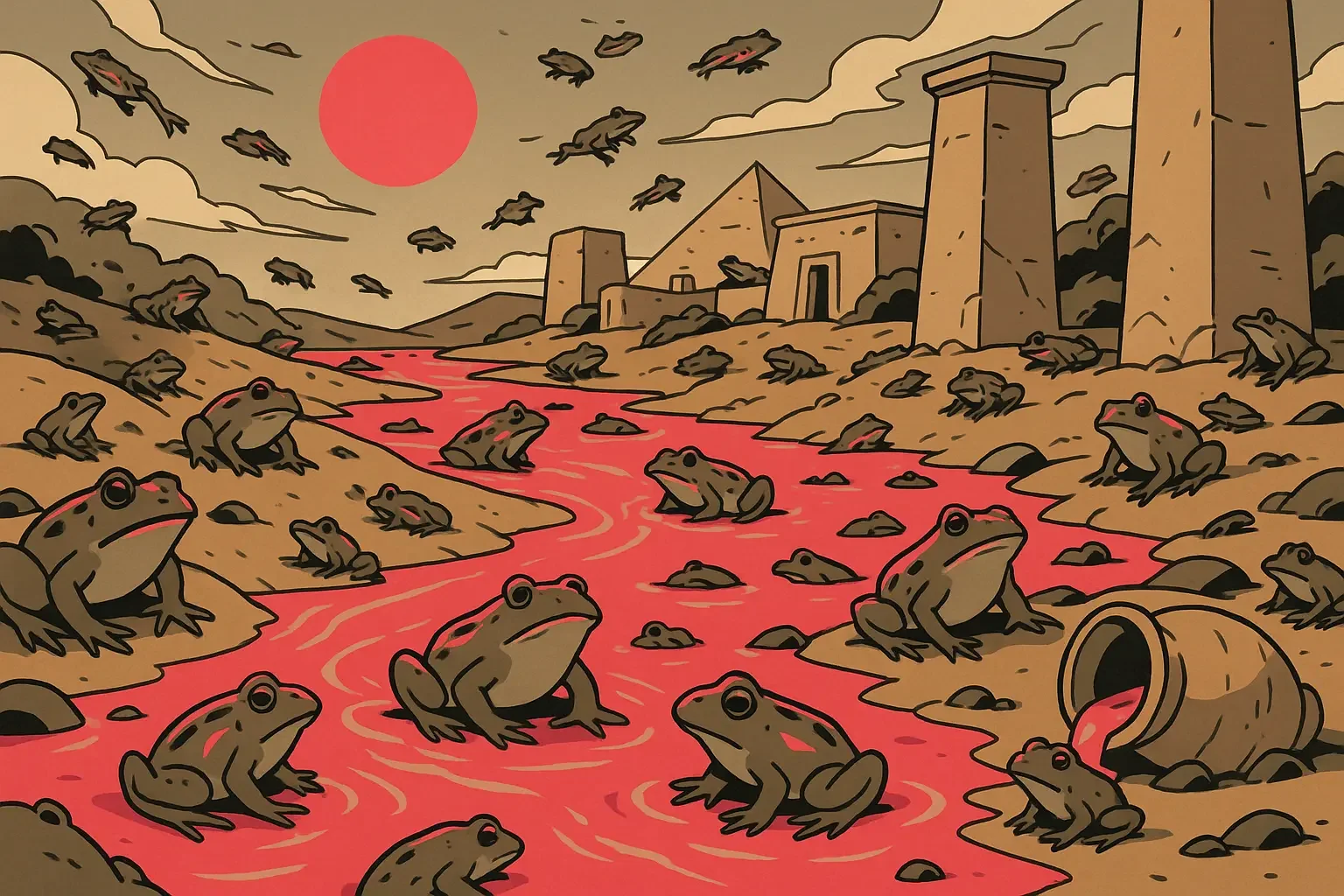
Exploring the Foundational Story of Divine Judgment, Hardened Hearts, and Miraculous Deliverance.
The Ten Plagues:
God's Power Over All the Gods of Egypt
Lesson 13: The Ten Plagues
The Confrontation: Pharaoh's Defiance Meets Divine Authority
After his encounter at the Burning Bush, Moses, accompanied by his brother Aaron, presented God’s demand to Pharaoh: “Let my people go, that they may hold a feast to me in the wilderness.” (Exodus 5:1) Pharaoh, the most powerful ruler in the world, simply scoffed, “Who is the Lord, that I should obey his voice and let Israel go? I do not know the Lord, and moreover, I will not let Israel go.” (Exodus 5:2)
The Ten Plagues are God’s answer to Pharaoh’s arrogance, designed to convince him (and the Israelites themselves) that "there is none like the Lord our God in all the earth" (Exodus 8:10).
I. The First Nine Plagues: Escalating Judgments
The first nine plagues escalated in severity, targeting different aspects of Egyptian life, economy, and, crucially, their religious beliefs.
Plagues 1–3 (Annoyance)Plagues 4–6 (Distinction)Plagues 7–9 (Devastation)1. Water to Blood: Targeted the Nile god (Hapi) and river purity.4. Flies: Targeted the god of dung beetles (Khepri).7. Hail and Fire: Targeted sky and storm gods (Nut, Shu).2. Frogs: Targeted the fertility goddess (Heket).5. Livestock Disease: Targeted the bull/cow gods (Apis, Hathor).8. Locusts: Targeted crop gods (Isis, Seth).3. Gnats (or Lice): Targeted the earth god (Geb) and the purity of priests.6. Boils: Targeted healing and medical gods (Imhotep).9. Darkness: Targeted the sun god (Ra)—Egypt’s supreme deity.
God's Distinction: Starting with the fourth plague, God made a distinction: the judgments fell only on the Egyptians, while the Israelites, protected in the region of Goshen, were spared. This showed the Egyptians that this was not a random catastrophe, but a targeted, purposeful judgment from the God of Israel.
Pharaoh's Hardness: After each plague, Pharaoh would temporarily concede to let the people go, only to harden his heart and refuse once the plague was lifted. The Bible states both that God hardened Pharaoh's heart and that Pharaoh hardened his own heart, showing a mysterious interplay between human choice and divine purpose.
II. The Tenth Plague: The Passover
The final and most terrifying plague was announced as the one that would break Pharaoh's will and secure the release of the Israelites.
The Judgment: The death of the firstborn son in every Egyptian household, both human and animal.
The Deliverance: God commanded the Israelites to prepare for an imminent departure. They were to take a perfect, unblemished lamb, sacrifice it, and spread its blood on the doorposts of their homes.
The Passover: When the angel of death (the Lord) passed through Egypt, he would "pass over" any house marked with the blood. This established the annual feast of Passover, a profound foreshadowing of Jesus Christ, the Lamb of God whose blood protects those who believe from eternal judgment (1 Corinthians 5:7).
III. Pharaoh's Submission and the Exodus
After the death of his own firstborn, Pharaoh finally submitted. He drove the Israelites out, commanding them to “Go, serve the Lord, as you have said!” (Exodus 12:31) The Israelites left Egypt, carrying not only their families and flocks but also the wealth of Egypt, which the Egyptians gave them out of fear, fulfilling God's earlier promise to Moses (Exodus 3:21–22).
Applying the Truth Today
The Ten Plagues teach us that God is the Sovereign over all earthly powers and false idols. He actively intervenes in history to bring justice and deliverance. Every plague that fell upon the Egyptians exposed the weakness of their false gods.
For us, this means that every power, addiction, or false idol (anything we worship instead of God) in our lives is utterly subject to the authority of the true God. The final plague, the Passover, gives us the central message of the Gospel: deliverance from judgment comes only through the blood of an innocent substitute.
Reflection Questions for Your Journey:
Pharaoh's Hard Heart. When God's truth is clear, what makes your own heart prone to resisting or "hardening" against His commands?
The Folly of Idols. Is there anything in your life that you rely on for security, power, or comfort more than you rely on God? How does the defeat of the Egyptian gods expose the folly of that idol?
The Substitute. The blood on the doorposts was the only thing that protected the Israelites. How does this story strengthen your appreciation for the saving power of Christ's sacrifice (His blood) that was shed for you?
Your Reading Guide
To understand the core conflict, read Pharaoh’s arrogant question in Exodus 5:1–2. Next, focus on the distinction God made between His people and the Egyptians in Exodus 8:22–23. Finally, read the essential instruction for the Passover in Exodus 12:5–13.